Tel Aviv University Study Explains How Sunflower Seedlings Combine Competing Light
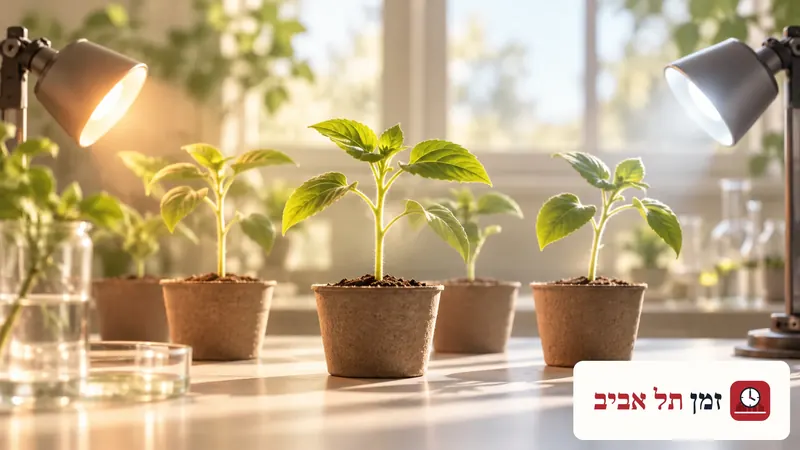
A sunflower seedling can grow towards a weaker light even when stronger lamps are shining nearby. A new study led from Tel Aviv University explains how that can happen: the plant combines locally processed signals around its stem, rather than simply following the largest amount of incoming light.
The research, published in PNAS and highlighted by the university on 11 October 2026, examines how a living system without a central brain produces a coordinated directional response. Its technology interest lies in distributed sensing, the relationship between many local inputs and one overall action. It is basic research, not an announcement of a commercial sensor or a municipal deployment.
One qualification matters from the outset. The experiments support the signal-integration mechanism, including a response to a weaker light. A separate, small directional distortion predicted by the model was below the experiment's resolution. The study therefore does not justify saying that every proposed optical-illusion effect was directly measured.
A local research result with a wider sensing question
The paper lists Ahron Kempinski, Amir Porat, Mathieu Rivière and Yasmine Meroz as its authors. Its Tel Aviv affiliation includes the university's School of Plant Science and Food Security. The journal record dates online publication to 22 September 2026, followed by the 29 September issue. The October university announcement brought the result to a broader audience.
The question is straightforward to state but harder to test. If light reaches different sides of a stem, how does the plant turn those separate inputs into a direction of growth? Measuring the external light alone does not tell a researcher how the organism processes it internally.
Think of the distinction as the difference between a measurement and the instructions produced from that measurement. Two systems can receive the same inputs and respond differently if their internal rules differ. The study investigates those rules through a combination of controlled experiments and mathematical modelling.
The order of the calculation changes the answer
In the university's account, sensing and processing occur locally around the stem. The response is nonlinear: increasing an incoming stimulus does not necessarily increase the resulting biological signal in direct proportion. The plant's overall response then combines the processed directional signals.
That order matters. Adding raw inputs and then processing the total need not give the same answer as processing each input first and combining the results. This is a mathematical distinction, not evidence that a plant is consciously making a choice.
An everyday comparison is useful, provided it stays a comparison. If each measurement passes through a different adjustment before the final result is calculated, the output can differ from the unadjusted total. In the plant study, the relevant adjustments arise from biological sensing and geometry. There is no hidden human-style observer inside the stem.
The authors used sunflower seedlings as the experimental system. The findings should not be retold as a measurement of every plant species or as a universal rule for positioning household plants.
Why the weaker light could determine the direction
The paper describes experiments with different lighting arrangements, including illumination from one side, opposing sides and another direction in space. A particularly clear test used balanced opposing cues together with a weaker source that broke the symmetry.
The seedlings responded towards that weaker source. Within the model, the stronger opposing contributions cancelled in the combined directional signal, leaving the additional cue to determine the response. The important point is the arrangement of the inputs, not merely a ranking of lamp brightness.
This gives the result an understandable experimental logic. A model becomes more useful when it predicts what happens after the arrangement changes. Researchers can then compare the predicted response with the observed growth, rather than only describing a pattern after seeing it.
The experiment concerns growth under controlled conditions. It is not a demonstration that a seedling can identify a lamp, recognise an object or choose an intention. Terms such as sensing and integration describe the mechanism being studied, without requiring those additional claims.
The optical-illusion label has a precise limit
The paper also compares the direction associated with physical illumination with the direction predicted after local, nonlinear processing. Those directions can differ in the model. That mismatch is the basis for the optical-illusion analogy.
The authors explicitly note that the small predicted deviations in their parameter range fell below experimental resolution. This separates two statements that can sound similar in a headline: evidence supporting the underlying mechanism, and direct measurement of every consequence predicted from it.
For readers, the distinction strengthens the explanation. A prediction can be scientifically useful without already being observed at the required precision. It identifies what a later experiment would need to resolve. Treating the prediction as a completed measurement would erase that next research question.
The work does not establish conscious visual experience in plants. Nor does it provide a tested method for increasing agricultural yields or improving a city's planting. Those would be separate questions requiring their own evidence.
What the result adds to Tel Aviv's innovation story
The university presents the framework as potentially relevant to other biological systems that integrate signals without a central brain. Potential relevance is the appropriate description: the reported experimental platform is sunflower seedlings, and applications beyond it need further work.
For a city audience accustomed to technology announcements centred on a finished product, this is an earlier stage of innovation. The contribution is a testable account of how information becomes coordinated behaviour. That can be valuable before anyone knows whether a particular device or application will follow.
A useful next test of the research programme would be whether the framework predicts responses in additional conditions and whether experiments can resolve the smaller directional effects. Those are questions raised by the study, not announced outcomes. For now, the concrete achievement is a clearer mechanism connecting local light sensing to whole-plant growth, developed through research with a direct Tel Aviv academic base.