Night works at Levinsky bridge on Namir Road: reported hours and access questions
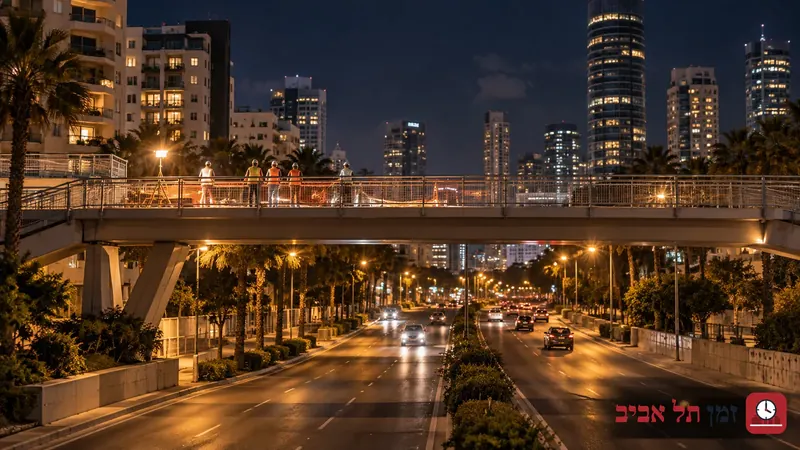
Night work is planned at the pedestrian bridge near Levinsky College on Namir Road, according to a report published by Tel Aviv Online on 12 October. The reported schedule is Sunday through Thursday, from 22:00 until 05:00, for approximately a month. That information establishes a proposed working pattern, but it does not establish a full road closure, the cancellation of bus stops or a pedestrian diversion. Those are separate details that need a current municipal notice.
The location is Namir Road, not Levinsky Street
The report identifies the bridge near Levinsky College on Namir Road. Readers should keep that location attached to the story when searching for an update. The name Levinsky can also suggest the street in southern Tel Aviv, but the work described here concerns a different place.
Tel Aviv Online attributes the planned programme to Tel Aviv-Yafo municipality in cooperation with Ramat Hasharon municipality. Its account describes work intended to improve bridge and traffic infrastructure safety, together with preparations for digital signage. It does not specify the content of that signage.
The report should not be read as a technical assessment of the bridge's present condition. A stated safety-related purpose is not evidence that the structure is currently unsafe. Likewise, preparation for signage does not establish what information it will display or when it will be activated. The story is about the reported works programme, within the limits of that description.
How to read the overnight schedule
The hours given are 22:00-05:00 on Sunday through Thursday nights. Because the period crosses midnight, its end falls on the following morning. A Thursday-night working period would therefore extend into Friday morning if carried out according to that schedule.
That distinction helps someone planning an early journey. The relevant question is not simply whether their travel day is listed as a work day, but whether the journey overlaps the end of the previous night's working period. This is an interpretation of the stated hours, not an additional announcement about Friday works.
The duration is described as approximately one month. The retrieved report does not give a clear starting date and finishing date, so it would be misleading to calculate and publish a firm completion day. An estimated duration is useful for recognising that the programme may affect repeated journeys; it is not the same as a dated assurance of completion.
Working hours do not define every traffic restriction
A schedule for construction activity does not by itself explain the traffic arrangements. The report checked for this article does not establish which lanes, if any, will be closed, whether pedestrians will use the bridge throughout the works or whether a diversion will be necessary at a particular stage.
It also does not identify cancelled bus stops or altered routes. Those should not be inferred simply because work is taking place above or beside a road. A bus passenger needs a route-specific notice if the journey depends on a particular stop; a driver needs the actual restriction, rather than a general assumption about roadworks.
For the same reason, the absence of a published restriction in this report is not a guarantee of unrestricted access. The useful next step is to check the current municipal information for the exact place and travel time. Until those details are available, a suggested diversion would be guesswork rather than practical reporting.
Where to look for a current access update
The municipality's public roadworks page explains that current street-closure information and a closure map are available through My DigiTel. That is an official route for checking access conditions. It does not, in the text retrieved for this article, independently confirm the specific bridge schedule.
The distinction between the programme and the live access information is useful. The programme explains the anticipated work, while a current closure notice should answer what is restricted at the time of a journey. A reader can use the first to recognise the location and the second to decide how to travel.
When checking an update, match the road name and bridge location rather than relying on the word Levinsky alone. Look for the effective dates and hours, and whether the information concerns vehicles, buses or pedestrians. Different access questions require different answers; a statement about one mode should not automatically be applied to all others.
The details still needed for a complete local notice
A fuller notice would establish the start and finish dates, the precise work limits and the access arrangements at each affected stage. For pedestrians, it would clarify whether the normal crossing remains usable and identify any accessible alternative where needed. For drivers and passengers, it would identify any actual restrictions or service changes.
The exact first-publication time of the bridge announcement was not established in the research. The local report is dated 12 October, but it is not evidence that the municipality first announced the work that day. The original dated notice and a traffic arrangement plan would resolve the most important gaps.
Readers making a repeated commute should therefore use the reported overnight pattern as a reason to check for updates, rather than as a complete route instruction. Keep the distinction between the work itself and its confirmed effects on access. Zman Tel Aviv's Tel Aviv section brings together local coverage, while a current official restriction is the information needed to finalise the particular journey.