How to Recycle at Home and Find Collection Points in Tel Aviv
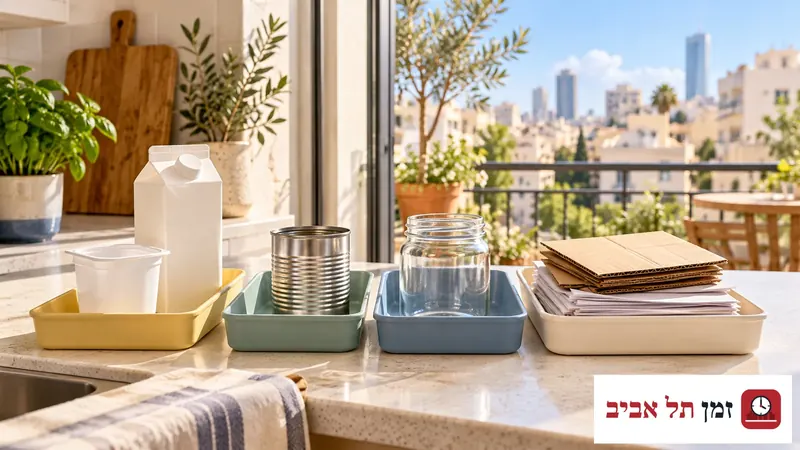
A milk carton and a cereal box look like related materials, but Tel Aviv-Yafo sends them to different recycling streams. The drink carton belongs in orange; thin cardboard belongs in blue. The practical starting point is to identify the item, separate it at home and locate the correct collection point before carrying it downstairs.
Check your building's bin enclosure first, then use the municipal recycling map for anything missing. At home, set aside places for packaging, paper and items requiring a separate trip. This guide covers everyday household materials, drawing on instructions from the municipality, packaging-recycling organization Tamir and electronics-recycling organization MAI.
Look inside the building before searching the street
Visit the shared bin enclosure and see what residents already have available. The municipality says its recycling map covers public collection facilities, excluding orange and blue bins on private residential property. A blank area around your address on the map therefore does not necessarily mean your building lacks those bins.
For other materials, find the waste-separation page and recycling map on the municipal website. Search for the type of facility you need, then consider a route you can comfortably use. The nearest marker in a straight line is not always the most convenient stop during an ordinary walk.
Note a glass collection point, the local arrangement for thick cardboard and a suitable electronics drop-off. Where a collection point is inside a building, check access hours too. A location marker does not mean a facility is accessible at all times or accepts every material.
If renting or staying with someone, ask the host or building representative where the shared recycling bins are. That specific question is easier to answer than how recycling works across the city. Start with the building's arrangements and use public facilities to fill the gaps.
Orange is for packaging, not every plastic object
Tamir identifies plastic packaging, metal packaging and beverage cartons as the orange-bin materials. An empty dairy tub, empty food tin and drink carton are useful examples. First ask whether the item is packaging. Being made of plastic does not automatically qualify a toy, household object or appliance.
Empty the contents before disposal. Tamir says washing packaging is unnecessary because it is washed during recycling. There is no need to turn sorting into another round of dishwashing. Remove remaining food into ordinary waste, then separate the empty packaging according to the instructions.
The municipality excludes glass and thick cardboard from the orange stream. Avoid collecting all packaging into one bag with the intention of putting the entire contents into orange. Keep a small space for jars and cardboard requiring another route, while you can still see exactly what is in your hand.
Use a collection container you already own if it suits the available space. The purpose is to make empty packaging easy to set aside, not to buy a new kitchen system. In a shared household, agree on a few familiar examples and a collection spot. Explaining the items you actually use is clearer than asking everyone to recycle everything.
Separate paper, thin cardboard and beverage cartons
The city's blue-bin instructions cover paper and thin cardboard, including newspapers and cereal boxes. Milk cartons go into orange. The English word carton is therefore not enough to decide the destination: identify the packaging type and follow its specific instruction.
Give paper a separate place so you do not have to retrieve it from packaging containing food remnants. In a small apartment, that might be a shelf or dedicated bag where you open mail and parcels. Choose a location that works with your routine and keeps walkways clear.
Where packaging has several components, look at each part separately. Do not let the appearance of the outer box determine the destination of everything inside. If the material or instruction is unclear, check the municipal or relevant recycling organization's guidance before disposal. Texture and color alone are poor substitutes for an item-specific answer.
A short household reminder can make the distinction memorable: cereal box to blue, drink carton to orange. It is a prompt, not a complete recycling dictionary. Add unfamiliar items only after checking them. That keeps the reminder useful for everyone who shares the kitchen, including visitors learning the local system.
Take empty glass packaging to its own container
The municipality directs empty glass packaging, such as coffee and jam jars, to the gray-purple container with lids removed. The category is glass packaging. Do not assume every transparent object belongs there; check separate guidance for an unfamiliar item before adding it to the jars.
Choose a carrying container suitable for a load you can comfortably manage. There is no need to wait for a large accumulation. If the glass point is on a regular route, take a smaller batch during an ordinary outing. This is a convenience suggestion, not a municipal collection schedule.
Keep glass apart from material going to orange. Before leaving, confirm that jars are empty and lids have been removed. A quick check at home is easier than sorting several bags while standing outside, particularly if other household members have added items.
If you cannot locate a mapped container, ask the municipal hotline for guidance and specify the address and material. It can also be the starting point for finding another location. Get a suitable destination rather than leaving the bag next to an unrelated facility. Save the convenient location once you have found it.
Flatten thick cardboard and arrange larger collections
Thick delivery boxes do not belong in orange. The city instructs residents to flatten them and use the building's waste-enclosure arrangement or a designated cardboard facility. Where thick cardboard cannot fit in the bin, its guidance is to leave it flattened beside the bin in the enclosure. That should not be read as permission to put boxes anywhere on the pavement.
For more than ten boxes, the municipality gives a separate process: flatten them, tie them into a stack and coordinate special collection with the nearest sanitation station. Find the relevant station through the municipal sanitation-stations page. Give the address and quantity and ask where and when to place the stack.
Before recycling a usable box, consider whether you need it for storage or can pass it to someone who does. Reuse is a separate option. Choose it when there is a real use and an agreed handover, rather than simply postponing the decision while boxes accumulate.
In a shared building, check the placement with the building representative. The municipal instruction and the physical enclosure need to work together so the bins remain accessible. Plan the destination before bringing down a substantial batch, rather than moving it first and seeking instructions afterward.
Use dedicated collection points for electronics and batteries
Chargers, cables and small electrical appliances require the electronics collection route. MAI's locator allows searches by item category and address or current location. Select what you actually have and check the chosen point's details. A battery collection point should not be assumed to accept every large appliance.
MAI's Tel Aviv-Yafo page describes separate containers for batteries and electronics at collection points. School facilities are used through the school community, so do not plan to walk into any school appearing in a list. Choose a suitable public-access location and confirm its hours before setting out.
MAI also distinguishes ordinary collection from dedicated facilities for electric-bicycle and scooter lithium batteries. For one of those batteries, use the specific search category rather than the first result for batteries. This guide does not provide dismantling or battery-handling instructions; ask the receiving organization for directions appropriate to the item before transporting it.
For equipment that still works, first consider continued use or an arranged handover. If recycling is the chosen route, make a short inventory before contacting the collection point. You can then ask whether it accepts everything you intend to bring.
Build a routine around the destinations you actually use
Different materials do not need to leave home together. Packaging and paper can follow the building arrangement, glass can travel separately and electronics can wait for a planned collection-point visit. Organize the routine around those destinations rather than the number of containers you can fit into the kitchen.
For municipal guidance, call *9106 from a mobile phone, use the 106 Plus app or submit an inquiry through the city website. Include the address and item type. If asking about a particular facility, identify its location and the kind of collection container involved.
Your next step can be small: check the building bins, choose a place for empty packaging and save one glass location and one electronics location. Once those routes are clear, each item has a destination before it leaves the apartment. The same routine is then easy to explain to a new flatmate or guest.