Tyre repair in Herzliya: when a puncture can be fixed
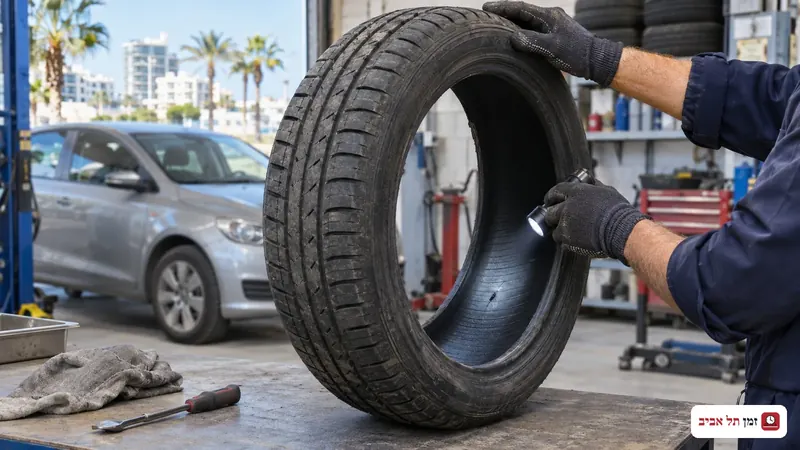
A screw in a tyre does not automatically mean buying a replacement. Equally, a small hole does not guarantee a safe repair. Start by deciding whether the car can be moved safely, then ask about the damage, the inspection and the work included in the quote.
For drivers commuting from Tel Aviv to Herzliya Pituach, or finding a flat in their residential car park, the immediate problem is practical: how to get the car dealt with. The nearest workshop is useful only if you can reach it safely. A clear phone conversation helps establish whether you need assistance where the car is parked or an appointment at a workshop.
Stop safely before choosing a workshop
If the car starts pulling unusually, a wheel becomes noisy or the steering feels different, slow gradually and find a safe place to stop. Michelin warns that driving on a flat can damage both the tyre and the wheel. A workshop being nearby does not make that journey safe.
Once stopped, check what help your roadside-assistance service can provide. Change a wheel only in a safe location and if you can follow the vehicle's instructions; arrange assistance on an exposed roadside. A temporary spare or sealant kit has its own limits. Consult the handbook rather than assuming either will suit every puncture or allow an ordinary journey.
Find the leak before deciding on the remedy
A tyre-pressure warning tells you something needs checking; it does not identify the fault. Michelin notes that pressure can escape through a valve or around the wheel as well as through tyre damage. Ask the technician to locate the leak before agreeing to a repair or replacement.
Explain whether pressure disappeared suddenly or fell over several days. Mention any kerb impact, driving after the tyre went flat, and use of sealant. Those details give the inspection a more useful starting point than simply reporting a puncture.
Location and condition determine whether repair is possible
The U.S. Tire Manufacturers Association, or USTMA, allows consideration of tread punctures up to 6 mm, subject to inspection and manufacturer restrictions. Shoulder or sidewall damage falls outside an ordinary repair. These technical criteria do not guarantee that every small hole qualifies.
The rest of the tyre matters too. Continental identifies structural damage, cracked or deteriorated rubber and damage caused by running without pressure as reasons a repair may be unsuitable. If replacement is recommended, ask to see the finding behind that decision. Understanding what failed is more useful than discussing the price of a new tyre alone.
For run-flat tyres, check the specific model's repair policy. USTMA notes that additional restrictions may apply. Tell the workshop how the vehicle was driven after the warning appeared.
A lasting repair includes an internal inspection
Michelin's repair guidance requires removing the tyre from the wheel for inspection. It describes a combined repair that fills the puncture channel and seals the tyre from the inside. An outside-only plug fitted while the tyre remains mounted does not replace that process.
The Tire Industry Association also cautions that emergency sealants are not long-term solutions. If you used a kit, follow its instructions for obtaining professional attention. At the workshop, ask whether the inside has been inspected and what repair method is proposed.
Give a precise Herzliya location
When checking local options, the Hebrew phrase תיקון צמיגים הרצליה means “tyre repair in Herzliya.” Be more specific when calling: say whether the car is in the city centre, Herzliya Pituach, a workplace car park or another location. For mobile assistance, explain the parking level, entrance height and any access restrictions. Confirm that the service can reach the car and deal with the problem there.
Before travelling to a workshop, confirm its exact entrance, the latest time it will accept a vehicle that day, the expected wait and replacement-tyre availability if needed. Check directly before a Friday or Saturday visit. An online listing is a starting point, rather than confirmation that someone is ready to receive the car.
For a stock enquiry, have the vehicle model, year and complete tyre markings available. A clear photograph can help if it can be taken safely while parked. Ask the workshop to check suitability against the vehicle's specifications and manufacturer instructions; wheel diameter alone is not a complete fitment specification.
Compare the work included in each quote
Request a breakdown covering inspection, repair, replacement and any call-out charge. Ask whether the total includes removal and refitting, balancing where required, a valve if needed, and VAT. Establish what you will owe if inspection shows the tyre cannot be repaired. This makes two quotations easier to compare without assuming they cover identical work.
If a replacement is proposed, request the exact make and model, size, load and speed ratings, and warranty terms. Before leaving, obtain an itemised invoice and ask how to monitor the pressure afterwards. Israel's National Road Safety Authority recommends checking pressure every two weeks, with the tyres cold and using the vehicle manufacturer's specified values. If pressure drops again, return for inspection with the record of the work. The useful outcome is knowing what caused the problem and what was done to resolve it.