Tel Aviv campus exhibition turns familiar building facades into architectural portraits
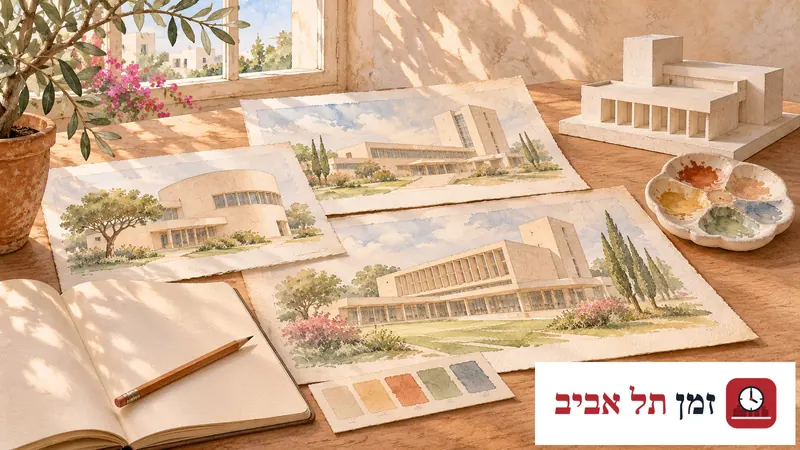
The buildings of Tel Aviv University are the subject of an exhibition that turns familiar facades into architectural portraits. Listed in the campus programme for November, Eyal Elron's "The Academic Front" is displayed in the reading room of the university's Social Sciences, Management and Education Library. The organiser says the exhibition continues until the end of December. Its subject is the architecture people pass on their way to something else.
One calendar detail needs care. A listing gives November 8, 2026, at noon, while the main exhibition page displays October 4 and other entries carry recurring dates. November 8 should therefore not be treated as an opening ceremony or a promised meeting with the artist. This is coverage of an ongoing exhibition, with practical information for an independent visit.
Looking straight at a building
The organiser describes Elron's approach as a nearly frontal view, combining architectural drawing with colour and texture. That provides a useful starting point for looking at a facade: the spacing of openings, the balance between solid surfaces and windows, and the arrangement of different parts. Architectural terminology is optional. A visitor can begin by noticing a repeated shape and following it across the picture.
Try separating description from explanation. A row of windows can be counted or compared without knowing what lies behind them. An entrance may appear central or offset, but its position alone does not explain how the building works. A painted surface might represent a material, or it might express an artistic choice. These are viewing questions, rather than findings about individual works in the exhibition.
The distinction matters because this article is based on the organiser's information, not a visit to the display. It does not identify an unverified list of featured buildings or offer a verdict on the paintings. Readers can use the exhibition's subject to develop their own questions without being told in advance what every image is supposed to mean.
What a facade can and cannot explain
A frontal image leaves much outside the frame. It may reveal the relationship between an entrance and the floors above it while saying little about the route through the interior. It can show an overhang without establishing how much shade it provides throughout the day. Looking carefully includes recognising which questions the picture cannot answer.
That is a useful habit beyond a campus exhibition. When considering a home, visitors often encounter photographs before floor plans. A facade image and an interior layout answer different questions. Neither should be asked to do the other's job. The exhibition offers an occasion to consider that difference; it is not a demonstration of a renovation system or a recommendation for a design supplier.
For a focused visit, choose one element to follow between images, such as the relationship between a doorway and the surface surrounding it. Then change the question and look again. This is an optional way to organise attention, not a guided activity advertised by the organiser. No particular viewing time or educational outcome has been promised.
A reading-room exhibition with practical opening hours
The library's visitor information states that entry to the library is free. Its regular opening hours are Sunday through Thursday, 08:00 to 20:00, and Friday, 08:00 to 12:45. Those are library hours. They should not be read as the schedule of a tour, talk or exhibition event.
No confirmed guided-tour timetable or event booking requirement was found in the exhibition information reviewed. Someone planning an independent visit can use the regular hours as a starting point and confirm access before making a special journey. If a separate activity is later advertised, its own conditions will need checking. Free library entry does not establish the terms of every possible event held there.
The setting also deserves attention. The works are in a reading room, rather than a separate venue identified solely with exhibitions. Groups should ask about arrangements for discussion or photography. Families can check whether a planned activity fits the space. These practical questions help match the visit to the venue without assuming services that the announcement does not offer.
Finding the room after reaching the campus
The library lists its address as 30 Haim Levanon Street, Tel Aviv. Inside the university, it is beside the Naftali Building and behind the Bar-Shira Auditorium. Keep the internal location as well as the street address: reaching a campus entrance is only one part of reaching a particular room.
The official directions identify nearby pedestrian entrances, including Ramniceanu Gate, numbered 4, and Frankel Gate, numbered 7. Joseph Kriss Gate, numbered 5, is a turnstile entrance described as accessible only with a staff or student card. Visitors without such a card should factor that restriction into their route. The directions do not establish that every other gate operates without conditions at all times.
The library's published telephone number is 03-6409361. Before travelling specifically for the exhibition, confirm the available entrance and current campus access arrangements. This article does not supply unverified bus routes, parking prices or journey times. Once the entry point is confirmed, visitors can plan the final walk as part of the journey rather than treating the street address as the destination's front door.
Check the complete accessible route
The library's accessibility information lists a ramp at its main entrance and access from the Naftali Building. It also describes a lift on the entrance level, along the corridor on the building's western side, and accessible toilets on several levels. These details help with planning, but the route from the chosen campus gate to the exhibition room still needs consideration.
Visitors can ask about the specific adjustment they need, whether step-free access, a place to pause on the way or convenient movement around the display. The reviewed announcement did not confirm English exhibition labels, an English-language tour or exhibition-specific accessibility aids. English-speaking visitors should check those points rather than assuming that a university venue supplies them automatically.
With the practical arrangements settled, the simplest viewing exercise remains available: select one opening, one repeated form or one transition between light and shade. Notice what the image shows, then identify what would require seeing the building itself. The questions can continue outside the reading room, where architecture becomes a place to enter and use again.