Reported Tel Aviv charging tariff update changes the full parking calculation
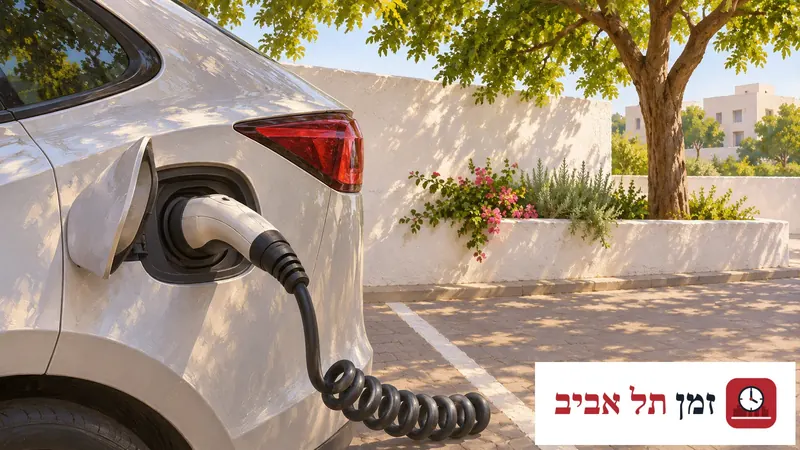
A reported charging-tariff change in Tel Aviv's municipal car parks alters the calculation for drivers combining parking with an electric-car top-up. Reports published by N12 and Bizportal on October 22, 2026, gave a price of NIS 1.24 per kilowatt-hour, compared with NIS 0.81 previously. That is a reported figure, not a live quote checked for every charger or customer account.
No public operator tariff notice was located confirming the new rate across all the car parks. The charging operator's official guidance says prices can vary by location, time and subscription, and directs users to the selected charger's price breakdown in its application. Before connecting, drivers therefore need two answers: the price of electricity at that point and the cost of occupying the car park while charging.
What changed in the reports
The coverage concerns chargers in Ahuzot HaHof municipal car parks. Bizportal describes an additional NIS 0.43 per kilowatt-hour. An exact effective date was not confirmed in a tariff document, so this article does not identify a day on which every customer's bill should have changed. Nor does the reporting establish a uniform price for all public charging points in Tel Aviv.
The figure is useful as news about an October consumer development. For a purchase now, however, open the specific charger's details and check the price displayed for the account being used. Confirm that the selected point is the one at which the vehicle is parked. A car park name alone may not describe every detail of the charging service.
Keep the unit price, charging type and any additional conditions together when comparing options. If something is unclear, resolve it before starting the session. A previous bill or another driver's screenshot may concern a different time, location or subscription. It cannot substitute for the terms shown for the session being purchased.
Energy and parking time are different units
A price per kilowatt-hour concerns the amount of energy delivered. Parking duration concerns time. If the price actually offered is NIS 1.24 per kilowatt-hour, purchasing 20 kilowatt-hours would cost NIS 24.80 for the energy component. This is a conditional arithmetic example, excluding parking and any other charges specified in the service terms.
At NIS 0.81 per kilowatt-hour, the same quantity would cost NIS 16.20, making the difference NIS 8.60. Holding the quantity constant isolates the effect of the unit price. Comparing two final bills without checking how much energy was purchased on each occasion does not, by itself, establish that a tariff changed.
The example should not be converted into a promised driving range. The energy shown on an invoice does not establish how far a particular car will travel, or whether its battery has been filled. Compare the billed units first. Drivers monitoring expenditure can record both kilowatt-hours delivered and the payment attributed to that energy, keeping parking separate.
Parking remains part of the total
The municipal parking company's official information says the applicable parking tariff is the one displayed on signs at the car park entrance. It also provides individual car park listings, while describing website information as informative. Drivers should therefore check parking terms independently of the charging screen. A clear electricity price is not a complete price for the visit.
A useful calculation separates energy, time spent parking and any other charge stated in the terms. This does not mean that every point imposes three charges. It is a way to avoid overlooking a component. If the terms mention remaining in a bay after charging finishes, check the exact condition rather than assuming it is identical across locations.
Ahuzot HaHof also publishes information about resident parking discounts. Rates and conditions appear on signs and car park listings, with vehicle recognition in automated facilities tied to the registration held by the municipality. That information concerns parking. It does not establish that a resident's parking benefit automatically discounts electricity or appears in a separate charging account.
Compare the same kind of charging
The charging operator explains that duration depends on factors including battery capacity, the charger's power and the vehicle's charging capability. Its guidance distinguishes ordinary alternating-current charging, known as AC, from faster direct-current charging, known as DC. A cost comparison needs to identify the service involved rather than treating every charging symbol on a map as equivalent.
Power, measured in kilowatts, and energy, measured in kilowatt-hours, answer different questions. One concerns rate; the other concerns quantity. A price per kilowatt-hour does not promise that a car will receive a particular power level throughout its session. This article therefore gives no guaranteed battery-filling time based on a charger's advertised maximum output.
Before making a special trip, check connection compatibility and availability as well. The operator's guidance distinguishes points with an attached cable from those requiring a suitable cable brought by the user. This is not a recommendation for a provider or product. It is a practical check to make before paying to enter a location for a service that may not fit the intended use.
Read the completed session as two transactions
After charging, retain the session summary and the parking payment record. Check the energy quantity, unit rate and components of the total. Where the invoice has several items, compare each with the conditions shown before starting. A higher overall bill can reflect different quantities or parking time, so begin with the components rather than assuming an error from the final number alone.
For an explanation, identify the charger, session time and particular charge that needs clarification. There is no need to publish card details or personal information. Direct the enquiry to the party named on the relevant payment record, since parking and charging may be handled through different systems. This article does not determine whether any individual customer is entitled to a refund.
The reported update is a reason to refresh the calculation before connecting. Start with the price displayed now, add the energy quantity being considered and account for the stay. That produces a usable estimate for the whole visit, rather than a decision based on one number beside a battery symbol.